

Bible Study Guide (Zechariah 8)
Introduction to the Book of Zechariah and the Foundation of Zechariah 8
The book of Zechariah introduces us to a man raised up by God at a uniquely appointed moment in Israel’s history. Zechariah was born in captivity among his own people who had been exiled to Babylon. He returned to Jerusalem after the release of the exiles at the conclusion of the 70 years of captivity. This period was prophesied by Jeremiah (Jeremiah 25:11–12; 29:10).
This return placed Zechariah at the center of national restoration. Jerusalem lay in ruins, and the Temple had been destroyed. Hope was fragile. Yet, God called Zechariah to minister during this rebuilding era. He served not merely as a prophet, but also as a priest—one of only three men in Scripture to hold both offices. The others were Jeremiah and Ezekiel.
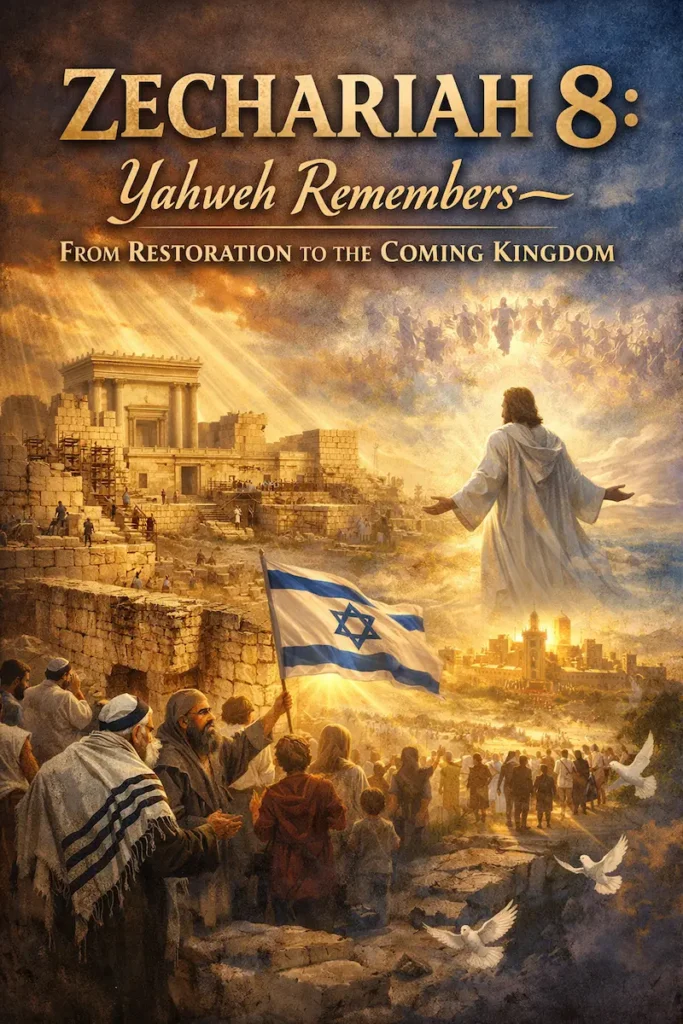
In ancient Israel, a priest represented the people before God, while a prophet represented God before the people. Zechariah fulfilled both roles faithfully. Though he likely did not envision himself returning from Babylon to serve as a priest, God sovereignly guided him into the Levitical priesthood. The book of Zechariah reflects the beautiful fulfillment of both responsibilities.
As the people faced what seemed like an impossible task—rebuilding the city and the Temple—the meaning of Zechariah’s very name became a message: “Yahweh remembers.” The first half of the book of Zechariah reflects his priestly ministry. He called the people to obedience while assuring them that God had not forgotten His covenant promises. Every promise would be fulfilled.
Throughout the book of Zechariah, God is repeatedly addressed as “the Lord Almighty”—a title emphasizing His sovereign power. This name appears no fewer than 53 times overall. In Zechariah 8 alone, it appears 18 times, underscoring God’s authority to accomplish everything He declares.
From Priestly Ministry to Prophecy
The second half of the book of Zechariah shifts toward prophetic revelation, unveiling Israel’s future and events unfolding even in our own generation. Zechariah was the second-to-last prophet to receive divine revelation before the four-hundred-year “period of silence” between the Old and New Testaments. This period is known as the Intertestamental period. Malachi would be the final prophet before that silence.
Zechariah prophesied roughly one hundred years before the period of silence began. This prophecy occurred nearly five hundred years before “the voice of one calling in the wilderness” (John the Baptist) announced the coming Messiah:
“And so John the Baptist appeared in the wilderness, preaching a baptism of repentance for the forgiveness of sins.” (Mark 1:4)
It is this prophetic dimension—especially revealed in Zechariah 8—that becomes the central focus of this study.
The Lord Returns to Zion (Zechariah 8:1–3)
(Verses 1-3) In Zechariah 8, verses 1–3 follow a familiar prophetic pattern found throughout the Old Testament. The prophecies culminate in restoration. This ultimately points beyond immediate fulfillment to the end of the age and the Millennial Kingdom.
Here, Zechariah speaks on behalf of God, drawing the reader forward into the coming days of Christ’s thousand-year reign on earth. These verses leave no doubt about God’s deep love for His people and His land. He is merciful and faithful. He remembers His promises and will fulfill every one of them.
Today, Israel is on the lips of every nation because Israel sits at the center of all of God’s prophetic purposes. Israel is God’s prophetic timepiece. God has not abandoned His people, nor will He ever. The modern nation of Israel stands as living testimony to that truth. It prospers in the midst of enemies and is preserved by the divine hand of God.
Regathering, Restoration, and National Marvel (Zechariah 8:4–8)
(Verses 4-5) This Zechariah 8 passage echo’s the powerful imagery of Ezekiel’s vision of the valley of dry bones in Ezekiel 37:
“This is what the Sovereign Lord says: My dry bones, I will open your graves and bring you up from them; I will bring you back to the land of Israel.” (Ezekiel 37:12)
Jerusalem’s streets will once again be filled with the elderly and the young. Laughter, conversation, and life will be restored by God Himself.
Israel stands alone in world history. No other nation has been fully dispersed, regathered to the same land, retained the same name, spoken the same language, and preserved the same ethnic identity. This alone testifies to God’s covenant faithfulness. Yet, God is not finished—He is still gathering His people home.
(Verse 6) Zechariah 8 asks whether such restoration is too marvelous for God. The implied answer is clear: absolutely not. The God of Israel will do even greater things.
(Verses 7–8) These verses further echo Ezekiel 37, confirming that this regathering is God’s doing alone. With the nation restored to the land, Aliyah continues even today. This is an ongoing fulfillment of prophecy and the strengthening of His nation.
Strength for Rebuilding and a Promise Renewed (Zechariah 8:9–13)
(Verses 9-13) In these Zechariah 8 verses, he brings us back to the immediate historical setting. The people of Judah had returned from Babylonian captivity. Under the leadership of Ezra and Nehemiah, they began rebuilding what the Chaldean army under King Nebuchadnezzar had destroyed.
They faced fierce opposition from those who had occupied Jerusalem during their absence. Yet Zechariah delivers encouragement from the Lord: Be strong.
Verse 11 marks a turning point. God declares He will now deal differently with the remnant. This points beyond their present efforts toward the future national restoration fulfilled in modern Israel. Yet this restoration is only the beginning of what God will accomplish.
Restoring the Heart, Not Just the City (Zechariah 8:14–17)
(Verses 14-17) Zechariah reveals a deeper truth. Ezra and Nehemiah quickly realized that rebuilding walls and temples was not enough. True restoration required transformed hearts.
Zechariah calls the people to truth, justice, and righteousness toward one another. God makes His position unmistakably clear:
“Do not plot evil against each other, and do not love to swear falsely. I hate all this,” declares the Lord. (Zechariah 8:17)
Paul’s Echo of the Book of Zechariah
The apostle Paul powerfully echoes the moral and spiritual heartbeat that’s required of God’s people presented in the book of Zechariah throughout his letters:
“Let love be without hypocrisy. Abhor what is evil; cling to what is good.” (Romans 12:9–10)
“Love does no harm to a neighbor. Therefore love is the fulfillment of the law.” (Romans 13:10)
“Finally, brothers and sisters, rejoice… and the God of love and peace will be with you.” (2 Corinthians 13:11)
“Be kind and compassionate to one another, forgiving each other, just as in Christ God forgave you.” (Ephesians 4:32)
“Over all these virtues put on love, which binds them all together in perfect unity.” (Colossians 3:14)
Paul’s instruction is not merely moral exhortation—it is Christ-shaped living flowing from the gospel.
Love, kindness, and fairness are not optional virtues. They are evidence of the new life in Christ, especially as the Church awaits His return.
From Fasting to Joy in the Coming Kingdom (Zechariah 8:18–19)
(Verses 18-19) Zechariah looks forward to the Millennial Kingdom, where mourning will give way to joy:
“He will wipe every tear from their eyes. There will be no more death or mourning or crying or pain.” (Revelation 21:4)
The fourth and fifth fasts are in sorrowful remembrance of the breach of the walls of Jerusalem in the days of King Zedekiah (Jeremiah 39:2; 52:6-7). He was the last king of Jerusalem before the Chaldean Army under King Nebuchadnezzar took the exiles of Judah and Jerusalem into Babylonian captivity for 70 years.
The seventh fast was in remembrance of the Jewish governor, Gedaliah, who was appointed by King Nebuchadnezzar (2 Kings 25:24-25; Jeremiah 41:1-3).
The tenth fast was in remembrance of the siege on Jerusalem by King Nebuchadnezzar in 580 BC (2 Kings 25:1-2; Ezekiel 24:1-2).
These historical fasts commemorating Jerusalem’s destruction will be transformed into celebrations of redemption and rejoicing during Christ’s reign.
The Nations Seek the Lord (Zechariah 8:20–23)
(Verses 20-23) These closing verses of Zechariah 8 point toward the Feast of Tabernacles (Feast of Booths) being celebrated during Christ’s reign in the Millennial Kingdom. Every nation will be required to come to Jerusalem. They will celebrate and tabernacle with Jesus in Jerusalem.
Zechariah expands on this vision in chapter 14:
“Then the survivors from all the nations that have attacked Jerusalem will go up year after year to worship the King.” (Zechariah 14:16–17)
(Verse 23) This verse paints one of the most dramatic changes that will take place in the Millennial Kingdom:
Paul tells us in his first letter to the Corinthians, “Now I know in part: then I shall know fully.” (1 Corinthians 13:12)
In other words, while God gives us a glimpse of our future with Jesus in the Millennial Kingdom, we really still know little. Our current minds comprehend even less the extraordinary changes that will take place in the coming Kingdom.
Verse 23 tells us of a dramatic shift in the world’s view of the Jewish people.
Today, every nation has their eyes on Israel. Most intentions are far from honorable as the world shouts out hatred for God’s people. This happens despite His unfailing love for them. As we grow closer to the return of Christ, antisemitism is going to grow stronger. Satan will set his eyes on destroying anything God loves, knowing his time is short.
But look carefully at this final verse. People will go out of their way to seek the Jewish people. They will understand in this time that they are God’s people. God’s people will lead them to Him as they seek knowledge of God.
What an absolutely incredible shift in the heart of humanity that will take place in the Millennial Kingdom after Christ returns.
“In those days ten people from all languages and nations will take firm hold of one Jew… and say, ‘Let us go with you, because we have heard that God is with you.’” (Zechariah 8:23)
What an unimaginable transformation awaits when Christ reigns—and what a powerful prophetic witness Zechariah 8 remains for our generation.
Closing Reflection: The Glory Yet to Be Revealed
From Moses to Isaiah, from Ezekiel to Zechariah, and from Daniel to John, the prophets spoke with one voice about a coming age when Christ Himself would reign over the earth in righteousness. The promise of the 1,000-year reign of Jesus in the Millennial Kingdom is not a minor theme in Scripture—it is a cornerstone of God’s redemptive plan, affirmed repeatedly by those who were given glimpses of what is to come.
Yet even with all that God has revealed through His prophets, we are reminded that what we know is only a fraction of the glory that awaits. Scripture gives us outlines, shadows, and assurances—but not the full picture. The world that emerges after the seven-year judgment will be unlike anything humanity has ever known. Justice will replace corruption. Peace will replace warfare. Truth will replace deception. And the King Himself will dwell among His people.
As Paul wrote:
“What no eye has seen, what no ear has heard, and what no human mind has conceived—the things God has prepared for those who love him.” (1 Corinthians 2:9)
The Millennial Kingdom will not merely be a restored world—it will be a transformed one. And even then, it will serve as a testimony to the greater eternal realities still ahead. Until that day, we live in hope, walk in faith, and look expectantly toward the return of the King, knowing that the greatest wonders of God’s plan are still before us.
To see how this promise of restoration unfolds into the final events of the age, explore the full Zechariah 8–14 prophetic overview.
Closing Prayer
Heavenly Father,
We thank You for Your faithful Word and for the prophets who spoke of the coming reign of Your Son. As we await the fulfillment of all You have promised, fix our hearts on the hope of Christ’s return and the glory of His Kingdom. Prepare us to live faithfully in these closing days of this age—walking in truth, love, and obedience. May our lives reflect our longing for the day when Jesus reigns in righteousness and peace over all the earth. We trust You for what is revealed, and we rest in awe of what is still to come.
In the precious name of Jesus,
Amen.
“Prophecy of the Messiah: The Final Voices Before the Silence” Zechariah 9:1-17 >>