

Introduction: The Meaning of Zechariah 11
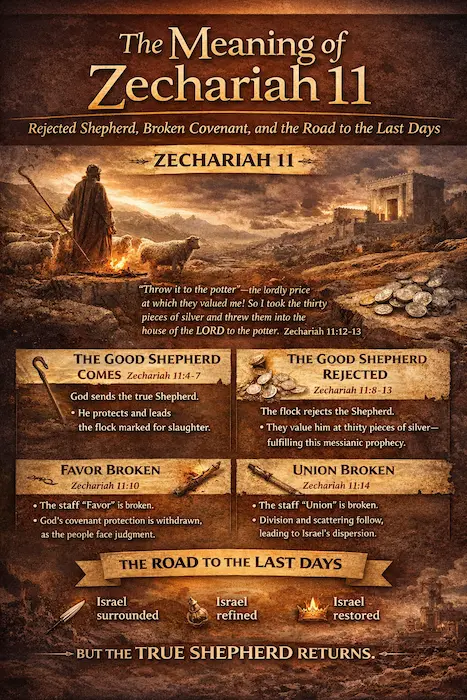
The meaning of Zechariah 11 marks one of the most sobering turning points in the entire prophetic book. Up to this chapter, Zechariah has emphasized restoration, regathering, and hope. But here, the tone shifts dramatically. Zechariah 11 explains why judgment came, why the Messiah was rejected, and why the last days must unfold as they will.
This chapter is not isolated prophecy. It is the theological hinge between promise and consequence. Any faithful commentary on Zechariah 11 must wrestle with rejection—rejection of God’s Shepherd, rejection of His leadership, and rejection of His covenant grace. Yet even in judgment, God’s sovereignty and faithfulness remain intact.
Judgment Announced Before the Shepherd Appears (Zechariah 11:1–3)
(Verses 1-3) The opening verses of Zechariah 11 introduce devastation through vivid imagery:
“Open your doors, Lebanon, so that fire may devour your cedars! Wail, you juniper, for the cedar has fallen; the stately trees are ruined! Wail, oaks of Bashan; the dense forest has been cut down! Listen to the wail of the shepherds; their rich pastures are destroyed! Listen to the roar of the lions; the lush thicket of the Jordan is ruined!” (Zechariah 11:1–3)
These verses signal judgment upon leadership and the land. The shepherds mourn because they have failed. The lions roar because power has become destructive rather than protective. This opening establishes the setting: the nation is vulnerable because its leaders are corrupt.
This pattern echoes throughout Scripture. When leadership collapses, judgment follows (Jeremiah 25:34–38; Ezekiel 34:1–10).
The True Shepherd Sent to a Doomed Flock (Zechariah 11:4–7)
(Verses 4-7) Here the heart of the meaning of Zechariah 11 begins to unfold. God commands Zechariah to act as a shepherd over a flock “marked for slaughter.” Zechariah is asked to foreshadow the ministry of Christ as Shepherd to His people, Israel.
Two staffs define the Shepherd’s ministry:
- Favor (Grace) — representing God’s covenant protection
- Union (Unity) — representing national and spiritual cohesion
“So I shepherded the flock marked for slaughter… taking two staffs, one called Favor and the other Union, and I shepherded the flock.” (Zechariah 11:7)
This is unmistakably messianic imagery pointing to the arrival of Messiah. God sends His Good Shepherd not to destroy, but to lead, protect, and restore. This Shepherd stands in stark contrast to the corrupt leaders already condemned.
This mirrors earlier prophecy spoken God through Ezekiel:
“I myself will tend my sheep and have them lie down, declares the Sovereign Lord.” (Ezekiel 34:15)
The Shepherd Is Rejected (Zechariah 11:8–11)
(Verses 8-11) Despite righteous leadership, the flock rejects the Shepherd. The breaking of the staff Favor signals a chilling moment:
“Then I broke my staff called Favor, in order to break the covenant I had made with all the nations.” (Zechariah 11:10)
It’s vitally important to understand, this does not mean God abandoned His covenant of salvation through Christ. It means covenant protection was judicially withdrawn due to rejection. The commentary on Zechariah 11 must stress this distinction: discipline is not abandonment. God disciplines those He loves.
“My son, do not make light of the Lord’s discipline,
and do not lose heart when he rebukes you,
6 because the Lord disciplines the one he loves,
and he chastens everyone he accepts as his son.” (Hebrews 12:5-6)
This rejection prophetically points to Israel’s response to Jesus at His first coming
“He came to that which was his own, but his own did not receive him.” (John 1:11)
“Jerusalem, Jerusalem, you who kill the prophets and stone those sent to you, how often I have longed to gather your children together, as a hen gathers her chicks under her wings, and you were not willing.” (Matthew 23:37)
Thirty Pieces of Silver (Commentary on Zechariah 11:12–13)
(Verses 12-13) Few passages are as direct as this:
“So they paid me thirty pieces of silver. And the Lord said to me, ‘Throw it to the potter’—the handsome price at which they valued me!” (Zechariah 11:12–13)
This exact sum appears again centuries later:
“So they counted out for him thirty pieces of silver.” (Matthew 26:15)
This is not coincidence. This is fulfillment. Any attempt at Zechariah 11 explained must acknowledge this as one of Scripture’s clearest messianic prophecies.
This foreshadows the price received by Judas Iscariot for betraying Messiah.
Unity Broken (Commentary on Zechariah 11:14)
(Verse 14) The second staff, Union, is broken:
“Then I broke my second staff called Union, breaking the family bond between Judah and Israel.” (Zechariah 11:14)
This symbolizes national fracture and dispersion. Historically, this unfolds in the destruction of Northern Israel by the Assyrian army and Judah and Jerusalem by the Babylonian’s. Followed by the scattering of the Jewish people. Prophetically, it explains the long delay between the Messiah’s first and second comings.
The Rise of the Worthless Shepherd (Zechariah 11:15–17)
(Verses 15-17) After rejecting the true Shepherd, the people are given a false one:
“For I am going to raise up a shepherd over the land who will not care for the lost… Woe to the worthless shepherd, who deserts the flock!” (Zechariah 11:16–17)
This foreshadows false leadership and end-times deception, culminating in the Antichrist (John 5:43; 2 Thessalonians 2:3–4).
“I have come in my Father’s name, and you do not accept me; but if someone else comes in his own name, you will accept him.” (John 5:43)
“Don’t let anyone deceive you in any way, for that day will not come until the rebellion occurs and the man of lawlessness is revealed, the man doomed to destruction. 4 He will oppose and will exalt himself over everything that is called God or is worshiped, so that he sets himself up in God’s temple, proclaiming himself to be God.” (2 Thessalonians 2:3-4)
Rejection of truth always invites deception. Where God is removed, Satan will always fill the void.
How Zechariah 11 Leads Into the Last Days (Zechariah 12–14)
The meaning of Zechariah 11 becomes clearer when viewed alongside the final chapters:
- Zechariah 11 — Rejected Shepherd
- Zechariah 12 — Israel at the center of the last days
- Zechariah 13 — Cleansing and refinement, preparing for the King and the Kingdom to come
- Zechariah 14 — The King returns
Israel’s rejection leads to discipline, but discipline prepares the way for the final and ultimate restoration for the remnant.
“They will look on me, the one they have pierced, and they will mourn for him.” (Zechariah 12:10)
Why the Meaning Matters Today
The meaning of Zechariah 11 explains the world we live in. It clarifies why history unfolded the way it did and why the final prophetic chapters are still ahead.
God’s promises were not canceled—they were postponed. And what has been postponed will be fulfilled. Especially as it relates to His people and His land.
The rejected Shepherd will return—not as the suffering servant, but as the reigning King.
Closing Reflection
The meaning of Zechariah 11 confronts us with a sobering truth: God’s faithfulness does not eliminate human responsibility. Yet even rejection cannot derail divine purpose. What was rejected once will be revealed in glory.
The Shepherd who was valued at thirty pieces of silver will one day rule the nations with justice, mercy, and power.
Closing Prayer
Faithful God,
As we come to the end of this chapter, we do not come to an ending but to a turning. You have shown us the cost of rejecting the true Shepherd, and yet You have also revealed a future filled with mercy, restoration, and purpose. We stand in awe of Your patience and Your unchanging covenant love.
Prepare our hearts for what lies ahead. As the days move toward the shaking of nations and the gathering of peoples against Jerusalem, teach us to see not fear but fulfillment. Open our eyes to recognize that You are still writing the story of Israel, still defending Your chosen city, and still calling Your people to look upon the One they once pierced.
Anchor us in truth as the world grows uncertain. Keep us watchful, humble, and faithful as Your plans move steadily toward completion. May we trust You fully—not only for what You have already fulfilled, but for all that remains. Strengthen our hope in the promise that You will pour out grace, bring repentance, and reveal Your glory in the last days.
Until that day, make us steadfast witnesses, praying, watching, and waiting with confidence in Your sovereign hand.
In Jesus’ name, Amen.
<< Zechariah 10 “Trusting God: The Cornerstone, the Tent Peg, and the Battle Bow” |