

Zechariah 10: The Trustworthiness of God in a Fallen World
Bible Study Guide
This Zechariah 10 Bible study will paint a picture of the trustworthiness of God. It will eventually lead to the culmination of events in the last days of this age.
Zechariah was one of the two last prophets to receive revelations from God about future events before the “silent period.” Malachi was the last. Of the many prophets of Israel, Zechariah was considered a minor prophet. This was not due to the importance of his message. It only points to the amount of prophecy that was given to him by God and recorded.
The four major prophets were Isaiah, Jeremiah, Ezekiel, and Daniel. This is evident by the size of their books and the words of God they recorded.
Daniel is about to lead his readers into some extraordinarily profound prophecies of the last days of this age. In normal biblical fashion, he follows the same ancient template (pattern) that his predecessors followed. First, God speaks to His nation and chosen people. This always serves to foreshadow future events that will eventually point to all nations and the events to follow of the days leading into the Tribulation.
Zechariah 10 will quickly establish the trustworthiness of God. Zechariah sets out to draw a clear line between trusting God or the idols and false leaders of His people.
Trusting God and Not Worthless Idols or False Leaders (Zechariah 10:1-3)
(Verse 1) Zechariah establishes God’s sovereignty over nations and creation. He makes clear that blessings are not happenstance (random events). They are direct intervention by God and blessings upon His people when they place their trust and reliance in Him. He will answer their prayers and bring blessings upon their much needed crops.
(Verse 2) The things that Israel has placed their trust in, such as idols are worthless and deceptive. Because they rely on these things and are led by false words from false shepherds, they wander like lost sheep. God’s blessings are absent because the people’s reliance on their One true God is absent.
(Verse 3) The work of the religious leaders of Israel that have led God’s people astray will not go unnoticed. God is faithful even when His people are not. He will restore Israel and the false shepherds will not escape punishment.
Zechariah’s reference to making Judah “like a proud horse in battle” indicates that Israel will achieve victory over it’s enemies. But this will not be the result of their efforts. It will only be accomplished by the power of God and their reliance and trust in Him.
Trustworthiness of God That He Will Go Before You (Zechariah 10:4-5)
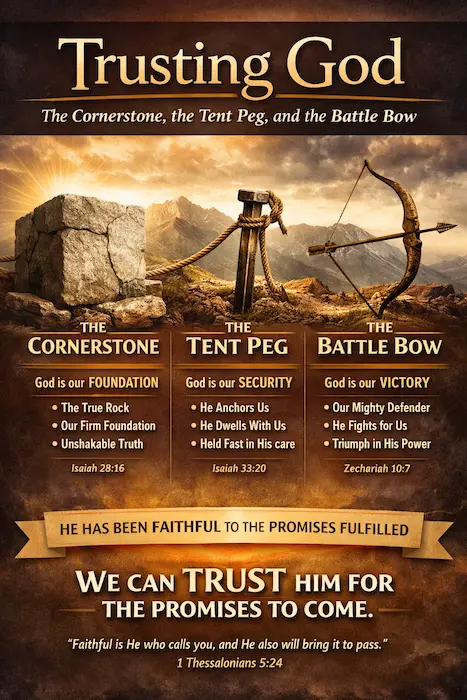
(Verses 4-5) The symbolism that Zechariah offers in these verses is stunning. They show the value of trusting in God and what that trust will deliver.
“From Judah will come the cornerstone,
from him the tent peg,
from him the battle bow,
from him every ruler.” (Zechariah 10:4)
Architecturally, the cornerstone was the first and most important stone laid. Every other stone was aligned to it. If the cornerstone was true, the entire structure stood firm; if it was flawed, the building failed.
Symbolism:
- Truth
- Stability
- What everything else depends upon
This imagery is why Scripture repeatedly uses the cornerstone to speak of God’s trustworthiness, unchanging truth, and His established purposes.
Unlike a cornerstone, which anchors a permanent structure, a tent peg secures a temporary dwelling. In the ancient world, tents represented daily life, pilgrimage, and dependence.
Symbolism:
- God’s sustaining presence in transient seasons
- Stability during wandering, testing, or transition
- Security provided by God, not permanence of place
This makes the tent peg especially meaningful in times of exile or waiting.
The bow was one of the most formidable weapons of the ancient world. It allowed a warrior or king to strike from a distance, often determining the battle before the enemy could engage.
Symbolism:
- Strength and might
- Ability to prevail over enemies
- Dominance without proximity
To “break the bow” symbolized the removal of military power and the end of conflict.
How They Work Together Theologically
Biblically, these images are complementary.
In Zechariah 10, the cornerstone, tent peg, and battle bow form a tightly woven theological group. Together, they present a complete picture of God’s redemptive plan—moving from foundation, to security, to victory. This is not random imagery. It is deliberate, covenantal, and deeply messianic.
This single verse functions like a compressed theology pointing to the coming of Jesus Christ, Messiah and eventually to His Kingdom.
Rejoice In the Trustworthiness of God’s Word (Zechariah 10:6-7)
(Verses 6-7) As the nation of Israel approaches the 400 period of “silence” from God’s Word, God encourages the nation before He begins to unfold the events of the last days of this current age.
Here in Zechariah, he encourages the nation of Israel. He tells them a time is coming when the full restoration of the nation will be observed brought about by the hand of God. The key phrase is, “They will be as though I had not rejected them.”
Israel today certainly does not look like a nation that had been rejected by God. They are a nation smaller than the state of New Jersey and having the greatest minority in population size. But they are a mighty and formidable nation against their enemies.
Israel is the only nation in the world that lives in its ancient land under the same ancient name. They are the only nation whose ethnicity remains unchanged, under the same ethnic name speaking the same ancient language. There is no other nation like it under the stars.
This is God’s restorative work in full view of all nations.
The mention of Ephraim in this passage is an all inclusive statement that all of Israel should rejoice because all of Israel will be restored. Zechariah 10 initially points to Judah (Southern Kingdom). The mention of Ephraim, son of Joseph which became the leading tribe of the Northern Kingdom of Israel points to the restoration of all of Israel.
Both kingdoms will be united once again under God’s redemptive plan for Israel.
Trusting God In the Restoration and Redemption of Israel (Zechariah 10:8-12)
(Verses 8-12) In Zechariah 10, Israel had not seen the last of the Jewish diaspora (scatter abroad). The Jews would again face dispersion from their land under the iron rule of Rome after Christ. But here, God promises restoration and redemption.
📖 Related Prophetic Bible Studies
Explore additional Scripture passages that align with the prophetic themes discussed in this study.
• Ezekiel 36:1-15 — God’s Promise to Restore the Land of Israel
• Ezekiel 36:16-38 — Understanding the Restoration of Israel
Today, we see this as fulfilled prophecy. Assurance of the trustworthiness of God that if He was faithful with these words of promise, He certainly can be trusted to fulfill what still remains to be accomplished.
Closing Reflection
Zechariah 10 reminds us that trusting God is never an act of blind faith—it is a response to a God who has already proven Himself faithful. Every promise fulfilled, every word brought to life, stands as a testimony that God does not forget, delay, or abandon what He has spoken. What He established, He sustained. What He began, He carried through.
When we look at Zechariah 10, we see a God who restores what was scattered, secures what was unstable, and defends what He has reclaimed. These are not symbolic hopes; they are fulfilled realities that anchor our confidence today. The same God who brought His people back, raised up deliverance, and aligned history to His purposes has not changed.
Trusting God means resting in the certainty that what remains unfulfilled is not forgotten—it is appointed. Prophecy still in waiting is not prophecy in doubt. It is promise moving toward its appointed time. Just as every fulfilled word strengthens our faith, every unfulfilled promise invites us to trust more deeply.
Zechariah 10 calls us to stand between what has been accomplished and what is yet to come with unwavering confidence in the character of God. He is faithful to finish what He has started. And because He has kept every promise behind us, we can trust Him completely with every promise still ahead.
This also applies to the plans and purpose God has for you right here right now. Paul said it best:
“because of your partnership in the gospel from the first day until now, 6 being confident of this, that he who began a good work in you will carry it on to completion until the day of Christ Jesus.” (Philippians 1:5-6)
Closing Prayer
Faithful God,
We thank You that You are the same yesterday, today, and forever. You have proven Yourself trustworthy through every promise fulfilled and every word brought to pass. Teach us to rest in You as we walk between what has been accomplished and what is yet to come. Strengthen our hearts to keep trusting You when fulfillment feels distant and hope is tested. Anchor us in Your truth, secure us in Your purposes, and lead us forward with confidence in Your faithfulness. We place our trust in You alone, knowing You will finish what You have begun.
In Jesus’ name, Amen.
<< Zechariah 9:1-17 “Prophecy of the Messiah: The Final Voices Before the Silence” | “The Meaning of Zechariah 11: Rejected Shepherd, Broken Covenant, and the Road to the Last Days” Zechariah 11 >>