

Why Religion Is a Lie—and Why Jesus Never Intended It to Save You
Some of you might be shocked at what I’m about to say. But this article is meant only to teach and awaken. It’s not meant to offend anyone—but to examine truth from a biblical perspective.
The question before us is not meant to provoke anger, but reflection. If religion is a lie, then what has humanity been clinging to for thousands of years? And if religion is not the answer, why does it dominate the spiritual conversation?
The Final Days Before the Cross: A Warning That Still Echoes
It was only a few days before Christ would be sentenced to death and crucified. It was a beautiful day. The disciples of Jesus had just finished commenting on the beauty and magnificence of their Jewish Temple.
They were only about a mile from the Temple, across the Kidron Valley on the east side of Jerusalem. Having ascended the Mount of Olives—where Jesus would later ascend into heaven, and where He will return at His Second Coming—Jesus prepared to give one of His final teachings.
This teaching would not focus on miracles or the coming Kingdom alone. Instead, it would awaken, warn, and expose something far deeper.
Jesus was about to deliver His Olivet Discourse—a prophetic teaching about the events of the last days of this age.
Did Jesus Warn That Religion Is a Lie?
As Jesus began to teach about future events, He could have started with any number of topics. Instead, He began with a warning that has plagued humanity since the fall in the Garden of Eden.
“Watch out that no one deceives you.” (Matthew 24:4)
Deception is not a new tactic. It is the very mechanism that transformed God’s good creation into a fallen one. Humanity’s vulnerability lies not in rebellion alone—but in believing we are doing right when we are not.
The serpent did not convince Eve to oppose God outright. Satan was far more subtle and cunning. He allowed Eve to believe that what she was doing was good in God’s eyes—while she was actually rebelling against Him.
“Now the serpent was more crafty than any of the wild animals the Lord God had made. He said to the woman, ‘Did God really say, “You must not eat from any tree in the garden”?’” (Genesis 3:1)
That seed of doubt became the foundation of what we see today—thousands of religions, all claiming truth, yet contradicting one another. If religion is a lie, then it began with the very first lie: questioning God’s Word. “Did God really mean what He said?”
If Religion Is a Lie, Why Are There So Many of Them?
If there is only one truth, why are there thousands of religions?
Satan deceived humanity in the Garden. Later, he attempted to deceive the early church—not by denying Christ outright, but by distorting who Jesus was and what salvation required.
Paul warned the Galatian believers of this very deception:
“I am astonished that you are so quickly deserting the one who called you to live in the grace of Christ and are turning to a different gospel—which is really no gospel at all. Evidently some people are throwing you into confusion and are trying to pervert the gospel of Christ.” (Galatians 1:6-7)
Evidently, the early Christian church struggled against the cunningness of Satan’s strategy to deceive believers. This has led generations since to question religion as a whole and to ask these questions.
What is religion? Is religion true? Which religion is right? Which religion should I join? It’s entirely normal to question the veracity of the thousands of religions that exist.
Is it possible there’s a reason why the same questions get asked generation after generation? Could we be looking for an answer that doesn’t exist? Or at a minimum, we can’t get to the answer that satisfies our inherent thirst and hunger to reunite with the One who created us?
Drawing A Line In the Sand
Paul fought to spread the gospel of Christ. To the disdain of many, he also drew a clear line in the sand. It separated Christianity (gospel of grace) and Judaism (religion of merit). Paul was saying you cannot intermingle the two. It’s one or the other. Paul refused to allow anyone to cross the line in the sand unless they understood that Christ, nothing else and no one else could lead them back to the Father (God).
The Catholic Church of Rome is a classic example of a religion that refused to cross Paul’s line in the sand into the full gospel of grace in our Lord Jesus Christ. They believe that the gospel is Jesus plus religious rules and traditions. This is opposes the Word of God. This is also when you turn Christianity into religion.
The Catholic Church still uses an altar for weekly sacrifice for the atoning of sins. Christ became the once and for all final sacrifice on the altar for the atonement of sins. He abolished the need for any altar for sacrificial rituals.
The Catholic Church still uses a priest for the rituals of the mass. The purpose of the priest was to be the representative of the people to God. He was to perform the sacrificial rituals for the atoning of sin. This never removed sin, it only covered it up. Christ’s sacrifice, once and for all removed sin. Christ became High Priest. He is our intercessor between God and those who believe in the atoning power of His grace by His shed blood on the cross.
The Catholic Church is a religion that places more emphasis on their sacrifices and rituals than on where their hearts stand in a relationship with Christ. I don’t speak from a point of ignorance. I spent more than 40 years in the Catholic church.
God spoke mightily about those who place emphasis on rituals and not on relationship.
“I hate, I despise your religious festivals;
your assemblies are a stench to me.
Even though you bring me burnt offerings and grain offerings,
I will not accept them.
Though you bring choice fellowship offerings,
I will have no regard for them.
Away with the noise of your songs!
I will not listen to the music of your harps.” (Amos 5:21-23)
Was Paul Saying That Religion Is a Lie?
Paul tried to make it very clear to the churches. You can’t mingle the gospel of grace with a gospel of merit. The free gift of salvation from God through Jesus Christ replaced all of the law that no one has ever been able to fulfill. Christ fulfilled it all for us. The gospel of merit claims that Christ is not enough. It says we must listen to what man says and add to Christ what still needs to be done in addition to what He did so that we might be saved and reunited with God.
The gospel of merit (under the law) commands to you, Do! Try! Behave!” The gospel of grace through Jesus Christ comforts you, saying, “Done! Trust! Believe!”
The gospel of merit (works under the law) is a false gospel. Paul was very clear about this. To add emphasis, he repeats his point.
“But even if we or an angel from heaven should preach a gospel other than the one we preached to you, let them be under God’s curse! 9 As we have already said, so now I say again: If anybody is preaching to you a gospel other than what you accepted, let them be under God’s curse!” (Galatians 1:8-9)

Here’s the truly striking reality about the Catholic Church of Rome. It teaches a false gospel that stands in direct opposition to what Paul is saying in these verses. Ironically, alongside Paul’s warning, the Roman Catholic Catechism itself repeatedly uses the language of “let them be cursed.” for those who do not believe in Catholic doctrine.
Please do not take my word for it. I do not speak from a position of ignorance or hearsay. I was a Catholic for over forty years and I know the system from the inside. Do exactly what the Bereans were commended for—test everything you hear against the Word of God. Do not test Scripture against the Catechism; test the Catechism against the gospel of Jesus Christ.
What Was Paul Really Trying to Say?
Generation after generation continues to ask the same unanswered questions about religion. Is there a reason for this? Is our focus on the wrong thing?
Man created religion. So he could have a relationship with God on his terms. Satan’s work has always been to stop the Word of God from spreading. He has failed at every attempt to silence it. What he has not failed at is deceiving mankind—just as he did in the Garden of Eden.
Satan created religion as a means of deception. He doesn’t want to scare people away from following Christ. He has a far more effective strategy than that. Satan would rather have you believe that you are following Christ while you are actually turning away from Him.
This is why Satan’s most powerful weapon is mankind’s religion. It teaches the very same deception first introduced in the Garden:
“Did God really say that?”
Or, “Did He really mean that Jesus was enough, or does He also want you to do this and that?”
Satan has no reason to change his strategy since it has been so effective as seen in the religious questions of confusion that remain unanswered. Satan shows us that religion is a lie.
This is the biggest lie perpetrated on humanity since that first encounter in Eden. Satan is a deceiver and a liar. In fact, he is called the father of lies.
Jesus spoke with piercing clarity to the Pharisees—men who clung tightly to religion and ritual while rejecting true faith:
“You belong to your father, the devil, and you want to carry out your father’s desires. He was a murderer from the beginning, not holding to the truth, for there is no truth in him. When he lies, he speaks his native language, for he is a liar and the father of lies.” (John 8:44)
Your Religion Is Lying to You
Nowhere in the sixty-six books of the Bible does it say that religion is the way to salvation in Christ Jesus. There is no requirement to join a religion. There is not a single verse that says religion is the way, the truth, and the life.
So if humanity continues to struggle with the same unanswered questions about religion, perhaps we are focused on the wrong thing altogether. What if, instead of focusing on the things of man—religion—we focused on the things of God—Jesus Christ? What would that reveal?
It would reveal the very message Paul fought to preserve against the Judaizers of his day: salvation is achieved through grace offered by God through Jesus Christ, not through the merit of mankind’s religion.
And now, here it is—the truth many are not ready to hear.
It’s not about religion.
It’s about relationship.
As God stated in no uncertain terms and Paul echoed: religion is a lie.
Once this truth settles in the heart, everything changes. When we turn our focus away from the works of Satan and toward the work of God, clarity replaces confusion. The endless questions about religion finally fade, because they were never meant to be answered in the first place.
It has never been about religion—it has always been about a personal relationship with the One who loves you so deeply that while you were still in your sins, He died for you on the cross. He did this so that you could be reunited with God and finally satisfy the deep, inherent hunger of your soul.
Are You Ready to Hear Something Truly Revolutionary?
All of this can be summed up in a few of the most powerful words ever spoken by Jesus:
“Jesus answered, ‘I am the way and the truth and the life. No one comes to the Father except through me.’” (John 14:6)
We come to know our Lord and Savior not by adding to His message and not by subtracting from it—but by believing it exactly as He gave it.
So here it is. This is meant to drive the point home, not to create a new system or way of life.
Did you know that you can repent of your sins, ask Christ to forgive you, believe that Jesus is the Son of God who died and rose again to save you from your sins, and accept Him as your Lord and Savior—and never enter another church building again—and you will be saved?
That statement is not meant to discourage fellowship. It is meant to expose the truth.
Salvation is not about religion; it is about relationship. Fellowship, discipleship, and gathering with other believers are deeply beneficial for spiritual growth—but they are not conditions or requirements for salvation. They are a recommendation, not a prerequisite, as you strengthen your walk with Jesus.
Many people treat Sunday church attendance as spiritual insurance. As long as they make their weekly trek, they believe they remain in good standing with God and are assured of salvation. This article may unsettle that belief for some.
I pray that you’re not one of them. Trust in Christ and Christ alone. Focus on the Words of God and not on the words of humanity.
Closing Reflection
Friends, pause for a moment—and be honest with yourself.
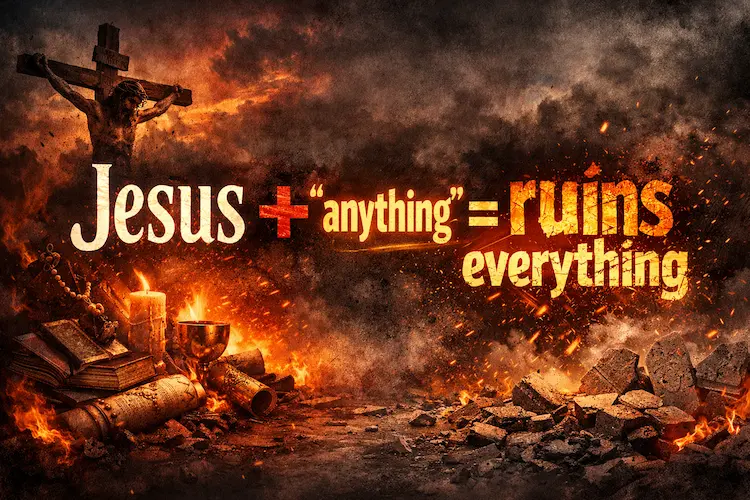
Strip away the labels, the traditions, the routines, and the assumptions you’ve carried for years. Ask yourself one simple but eternal question: What am I really trusting in? Is it Christ alone—or Christ plus something else?
Because anything added to Jesus subtly shifts trust away from Him. And what begins as devotion quietly becomes dependence on works, systems, or rituals that were never meant to save.
This is not a call to abandon fellowship, Scripture, or obedience. It is a call to examine whether those things flow from faith—or are being used in place of it.
Eternity is too serious to assume we are right without testing what we believe against the Word of God. The gospel is not complicated, but it is exclusive. Jesus did not leave room for additions, upgrades, or supplements.
So don’t ask which religion feels right.
Ask whether Christ alone is enough. He is and always will be!
Because if Jesus + anything = ruins everything, then the most important thing you can do is make sure that what you’re holding onto hasn’t quietly replaced Him.
And yes, it does matter the church you attend!